Alchemised
Prologue – Chapter 10
Being such a fan of the original work, separating them has been a challenge for me. The differences are clear and stark from the jump, with this short but important prologue where we meet Helena, in a perpetual state of limbo. Aware, awake, and consistently jolted by a bolt of energy every three hours.
I noted the line, “but someday, someone would come for her,” asking myself: does she say this because she is waiting for just anyone to come for her -friend or foe – or does her subconscious have a specific someone in mind, just out of reach?
Delving into this world was a bit of an undertaking. Unlike the original source material, we do not already love and adore these characters. We do not understand the laws and limitations of a “magic system” or what the sociopolitical climate is upon entering this new world.
Sen did a really fantastic job of squeezing a ton of exposition into these starter chapters, but it isn’t without its frustrations of keeping it all straight. I am not someone who reaches for a science novel, so changing “magic” to Alchemy is causing a large mindset shift.
There is true science and theory behind the practice of Alchemy, which was really just the precursor to Chemistry. I joke that my reading and comprehension ACT score in high school was near perfect, but my science and math scores were so low that they brought down my average by a laughable amount. Since the release on Monday (I write this as of Saturday, September 27, 2025), there have been quite a few handy guides that have surfaced from fans outlining what they know of the different variations, limitations, uses, and results for each type of Alchemical act. I will attempt to make my own with the knowledge we have gained from here.
As our understanding and exposure to these important terms expands in later chapters, I will add additional information in those reports.
Important & Key Words
Necromancer
A Necromancer is a person who has the ability to reanimate the dead (Necrothralls) and control them to do their bidding, whether that is slave work or to assist in the slaughter of their once living selves’ friends and loved ones.
“When the Eternal Flame moved to restore order, the Undying revealed another ability: necromancy..Rather than recruiting heavily from among the Aspirants, when attacked they’d kill the Eternal Flame’s soldiers, and then use reanimation to turn them back on their own compatriots, building an army with the Eternal Flame’s dead…Necromancy had been a mortal crime throughout most of the continent for centuries.” (p. 43).
“Usually, resonance was channelled into the alchemy of metals and inorganic compounds, allowing for transmutation or alchemisation. However, in a defective soul which rebelled against Sol’s natural laws, the resonance could be corrupted, enabling… the necromancy used to create necrothralls.” (p. 15).
Necrothrall
Necrothralls are the reanimated bodies of the dead – often used by the Undying as servants. Though they are reanimated, it does not stop them from the effects of decay.
Helpful Mentions:
“The stench of chemical preservatives and old meat burned in her nose. Necrothralls.” (p. 7)
“There was a necrothrall somewhere nearby. Alone and able to focus, Helena could smell the rotting meat and chemical preservatives. The Undying used the dead like puppets to perform any undesirable or menial tasks.” (p. 17).
“A necrothrall, an empty automaton corpse.”(p. 10).
“She glanced nervously towards the figures, which seemed to move as a collective. Necrothralls. They were all necrothralls.” (p. 21).
“…the necrothralls were horrifying to see. The adipocere gave a taut waxy sheen to the greyish-purple mottling of their skin, and the sclera around their clouding pupils were red or vivid yellow. Their fingertips were blackened and rotting off. The smell of chemical preservatives and rot made Helena sick…” (pp. 44-45).
“They use the greys for listening sometimes. There’s one in here, can’t you smell it? (p. 18).
Vivimancer
Vivimancy is the ability to affect the living in the same way Necromancers affect the dead. Manipulating the physical aspects of a living human.
Notable Known Vivimancers:
- Helena Marino
- Dr. Stroud
- Warden Mandl
- Kaine Ferron
The woman’s resonance was still running through her like a current, a visceral warning. Helena managed to nod shakily. She should have realised: The woman was a vivimancer. Necromancy’s inverse twin, wielded on the living rather than the dead. (p. 11).
“He’s some kind of vivimancer, but not like the rest. He kills people without even touching them.” “Resonance doesn’t work like that,” Helena said, correcting her reflexively. “Without an array, a stable channel has to be formed through contact, and then—” “I know how resonance works,” Grace said sharply. “But I’ve seen him do it.” (p. 20).
Stroud was unveiled in her disdain for Helena with the revelation that they were both vivimancers, but on opposite sides in the war. Stroud considered her a traitor. (p. 39).
Although healers were relatively common in the remote parts of Paladia, vivimancy was rare enough that there were all kinds of claims about what vivimancers were capable of—that they could enthral the living just as necromancers enthralled the dead, for instance, and perform unspeakable transmutations upon living flesh. Helena used to think these views of vivimancers unreasonably harsh, but now as Stroud’s subject, she began to understand. (p. 44).
Transmutation
Though a solid definition within the world of Alchemised has not been fully outlined up until this point, we can infer that it most likely means the following: Transmutation is the action of changing or the state of being changed into another form. In this world, we see it with Aurelia changing her rings and lengthening them into pointed knives, as well as the theory that Helena ‘transmutated’ her own mind by altering her own memories.
“There are barriers, transmutationally crafted, and so instead of following a natural pattern through the brain, someone has created alternative routes.”(p. 13).
“Usually, resonance was channelled into the alchemy of metals and inorganic compounds, allowing for transmutation or alchemisation.” (p. 15).
“The study of Northern Alchemy itself was entwined with the Tower structure. The lowest five levels with the largest lecture halls were the “foundations,” filled with initiates still discovering their resonance and mastering basic transmutation principles” (pp. 36-37)
Resonance
Think of Resonance as someone’s ‘magical’ abilities. It can be bolstered by certain metals, it can be felt by a person who is on the receiving end of it, it is ones ability to utilize the metals around them to hone in their abilities.
“By its nature, lumithium bound the four elements of air, water, earth, and fire together, and in that binding, resonance was created.” (p. 15)
“Usually, resonance was channelled into the alchemy of metals and inorganic compounds, allowing for transmutation or alchemisation.” (p. 15). (Function). Kindle Edition.
“They had formed the very first iron guild shortly after Paladia’s founding. Iron was one of the eight traditional metals associated with the eight planets: lead for Saturn, tin for Jupiter, iron for Mars, copper for Venus, quicksilver for Mercury, silver for Luna, lumithium for Lumithia, and gold for Sol.” (p. 66).
Transference
Inferred definition: The act of a living being possessing or transferring the soul into another living person, leading to animancy. Helena explicitly tells us these are terms she is unaware of.
“Souls and minds and occupying the mental landscape of another person to transmute them from within.” (p. 38).
“Helena suspected this was why Morrough was so interested in transference—the method had the potential to allow the Undying to move into living bodies instead.” (p. 45)
“She could only guess at what transference would entail. She thought of Crowther’s corpse in Central with the lich inside it. Perhaps that would be her soon, except still alive, aware of what was happening to her as Ferron took over, possessing her mind and body.” (p. 66)
Pyromancy
Pyromancy was one of Sol’s unique gifts to the Holdfasts, alongside the alchemisation of gold. The family was “always depicted wreathed in fire,” and Luc embodied this gift, making flames “shine like a star in his hand.” Unlike gold, which carried strict sacred rules, fire had fewer restrictions – letting pyromancy feel “more like magic than alchemy.” to Helena
Notable Known Pyromancers:
- The Holdfasts
- Jan Crowther
Characters of Note
Helena Marino
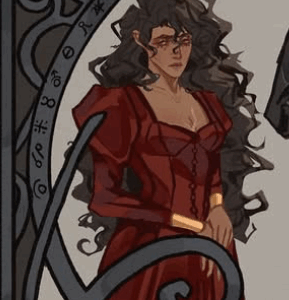
Helena, a savant Vivimancer Resistance healer and a member of The Order of the Eternal Flame, is currently being held captive at the estate of Kaine Ferron.
Notable Identifiers:
- Long Black Hair – kept in two tight plaits fastened at the base of her neck while healing
- Scars
- Large raised scar running between her breasts – as if her sternum had been opened and she was stapled back together left to heal without vivimancy
- Traces of a large circular wound going through her calf
- Stomach
- Between two ribs
- Right palm
- Slits as though she gripped a knife in her hand
- Seven tiny punctures perfectly spaced in a circle – familiar shape to Helena
- Below jaw – thin across the left side of neck stopping just shy of her throat
- Gold Manacles
- Wearing poorly dyed secondhand red dresses
- In her 20s
- Wrists broken several times – no recollection
Family Members:
- Father – Minor Resonance to Steel and Copper
- Mother – No Resonance
Background:
- Born in Etras
- Immigrated to Paladia at 10 years old to attend the Alchemy Institute – where she was sponsored by the Holdfasts. She completed 6 years of education
- Speaks with what a Paladian would consider an accent
- Volleyed for top marks at the institute between herself and Ferron
- Suffers from a 19 month gap in her memories which occurred during the War
- Kept in a stasis tank for 14 months after her capture during the Final Battle
Doctor Stroud
A female Vivimancer.
Luc Holdfast
Family Members:
- Principate Apollo Holfast – Deceased
- Ilva Holdfast – Great-Aunt – A Lapse (a child of alchemists who never manifested Resonance)
Lila Bayard
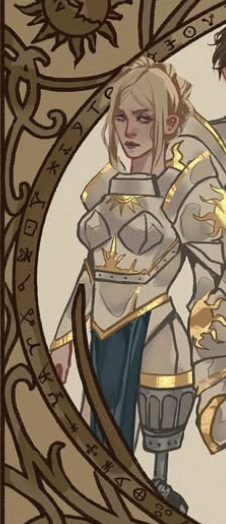
Lorem ipsum dolor sit amet, consectetur adipiscing elit. Ut elit tellus, luctus nec ullamcorper mattis, pulvinar dapibus leo.
Morrough/The High Necromancer
The act of a living being possessing or transferring the soul into another living person, leading to animancy.
“Alteration of a mind, the transference of a soul: Surely that would be seen as infinitely worse.” (p. 38).
“Helena suspected this was why Morrough was so interested in transference—the method had the potential to allow the Undying to move into living bodies instead.” (p. 45)
“She could only guess at what transference would entail. She thought of Crowther’s corpse in Central with the lich inside it. Perhaps that would be her soon, except still alive, aware of what was happening to her as Ferron took over, possessing her mind and body.” (p. 66)
Kaine Ferron/The High Reeve
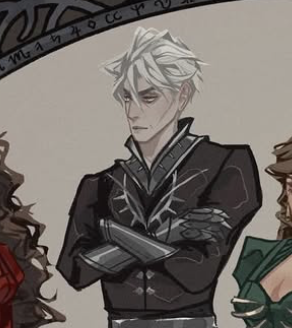
Son of
Notable Identifiers:
Aurelia Ferron
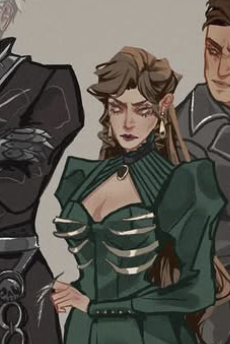
Lorem ipsum dolor sit amet, consectetur adipiscing elit. Ut elit tellus, luctus nec ullamcorper mattis, pulvinar dapibus leo.
Other Small Characters
Grace
Warden Mandl
Penny
Jan Crowther
Shiseo
Elain Boyle
Stuttering Consultant
Artemon Bennet
World Building & Landmarks
Paladia
Geography & Layout:
Built on a river delta in the Novis Mountains basin.
East Island: Original settlement with the Alchemy Tower, government, industry, trade, and the Faith’s cathedrals.
West Island: Later expansion, newer and grander, engineered for the booming population.
Mainland: Mines, agriculture, and estates of old Institute families (such as Spirefell); post-war, some estates seized and reassigned.
A vertical city, laced with skybridges – some narrow passages, others massive plazas and gardens high above the ground. The lower levels, starved of sunlight, became disease-ridden slums.
Symbolism & Beauty:
Once described as a crown laid among the mountains, its spires gleaming in the sun.
For Helena, arriving in Paladia felt like coming home – her destiny bound to the Institute at its heart.
Faith & Resonance:
Seen as Sol’s chosen nation, blessed with unusually high levels of resonance (nearly a fifth of the population pre-war).
Considered a sacred center of both Faith and alchemical progress, drawing pilgrims and scholars alike.
Social Divisions:
Holdfasts & Devout Families: Tied closely to the Faith, holding moral and historic prestige.
Guilds: Wealthy, powerful, and status-driven; their students treated Institute study as a formality.
Outsiders like Helena: Faced prejudice, mockery, and exclusion but also embodied the Institute’s original purpose of opening opportunity beyond privilege.
Politics & Power Struggles:
Murder of Principate Apollo allowed the guilds to push reform, replacing warrior and religious elites with the Guild Assembly.
This shift deepened tensions between tradition, faith, and industrial guild power.
The War’s Scars:
East Island still bears ruins and bombed-out gaps in its skyline.
West Island gleams, largely untouched, a stark reminder of inequality.
Etras
- Geography & Resources: A coastal region of cliffs, tide pools, farms, and villages; limited in natural metal, which stunted the growth of alchemy guilds and formal training.
Culture & Language: Known for its melodic dialect, lively culture, and expressive use of gestures – features that marked Helena as an outsider in Paladia. After seeing the musical reference (The channel of energy sang through her like a tuning fork, until both resonated along the same wavelength…like cymbals slammed together) I wonder if the people of Etras are prone to be musically inclined, hence Helena’s distinction that their dialects are melodic.
Daily Life: Characterized by painted carts pulled by donkeys, olive farming, and the vibrant presence of the sea, especially during summer Abeyance when the tide revealed hidden treasures.
Current Politics: The government publicly denies links to the Eternal Flame when asked about Helena.
Alchemy Institute/Central
The Alchemy Institute
Embodies both the heights of human achievement and the devastation of its fall, making it pivitol to the world’s history and Helena’s journey.
Origins: Began as a memorial after the first Necromancy War; grew into a towering symbol of knowledge and progress.
Architecture: Expanded over centuries with alchemical engineering; tallest building in the Northern continent for generations.
Structure of Study: Lower levels housed initiates; higher levels reserved for advanced students and grandmasters. Advancement required annual exams.
Purpose: Founded by the Holdfasts to open alchemy to all, not just the privileged guilds. For guild students, attendance was status; for others, it was opportunity.
Meaning: Once a place of beauty, pride, and hope now ravaged, its legacy desecrated.
Central
Transformation: The Tower, once the heart of Paladia, was stripped of its history, art, and beauty.
Current Role: Now called Central – the base of the Undying’s experiments.
Atmosphere: Cold, brutal, and raw, a haunting echo of its former grandeur.
The Outpost
Purpose: A prison-like labor camp where surviving captives are sent if not killed or reanimated for the mines.
Conditions:
Prisoners wear copper wrist cuffs to enforce curfews and daily check-ins.
Escape is nearly impossible – missing even one check-in results in the High Reeve hunting them down, usually ending in execution.
The Warden enforces order through terror: public hangings, reanimation of corpses as warnings, and brutal punishments for minor offenses.
Life Inside:
Food is scarce and often rotten; smuggling leads to mass executions.
Work is grueling, with the constant threat of being sent to the lumithium mines.
Prisoners are treated as expendable test subjects, even used in experiments such as forced breeding programs to study resonance inheritance.
The Mines
The Mines represent both Paladia’s wealth and its greatest moral failing:
Resource & Danger:
Lumithium is vital for alchemy but toxic to those with resonance.
Only non-resonant workers can mine it safely, yet their children almost always develop resonance, making labor supply unstable.
Social & Political Impact:
Mining created rapid population growth and urban overcrowding.
Tensions arose between miners, guilds, and the Institute:
Guilds: Wanted limited Institute admissions to protect their own heirs’ advantages and keep uncertified labor cheap.
Miners: Wanted opportunity and fair recognition for their children’s resonance.
Institute: Caught at capacity, unable to satisfy demand.
This imbalance fueled strikes, riots, and long-standing grievances.
Exploitation & Cruelty:
Prisoners and executed captives were often reanimated and sent to the mines as necrothralls.
Corpses were preserved for “clean” reanimation to extend their use.
The Undying’s “Solution”:
Replaced living miners with necrothralls, avoiding labor shortages.
Ironically, the war’s devastation left so few living alchemists that a breeding program was needed to restore the population.
Spirefell
Origins & Purpose: Built as a grand estate to display the Ferron family’s wealth, power, and pride. Once opulent, now deteriorated. Kaine and Aurelia Ferron are the current residence of this mansion with Helena being held captive.
Architecture & Atmosphere: A cavernous, shadowed mansion filled with ornate stairways, metal filigree, and endless rooms. Despite its size, it feels untended – air stale, halls dimly lit, and the house itself oppressive, almost corpse-like.
Living House: Its wrought-iron features seem to shift and move, making the structure feel alive and dangerous as we see when Ferron’s father is dragged away by the seemingly sentient house.
Dark Elements: Within its rooms lie disturbing features: the Drawing Room holds a welded iron cage meant for prisoners and the largest alchemical array Helena has ever seen, a complex nine-point design unlike traditional forms.
Symbolism: Spirefell’s grandeur is undercut by decay and menace, reflecting both the Ferron family’s legacy and the corruption woven into their power.
The Faith
Core Beliefs on Soul & Body:
Soul and body remain bound until cremation.
Fire releases the soul, allowing it to ascend if the person lived virtuously.
Unburned bodies risk trapping and corrupting the soul, twisting it into pests, plagues, or dragging it into the Abyss.
Necromancy and reanimation are seen as grave dangers, corrupting even pure souls unless freed by sacred fire.
Resonance & the Divine:
Resonance is a sacred gift from Sol, god of Quintessence.
Most rare globally, but widespread in Paladia, considered Sol’s chosen nation.
Faith teaches resonance is not proof of purity, but an expression of humanity’s flawed state striving for purification.
Religious Practices & Symbols:
Jewellery, often with sunstones, worn by leaders and sold as sacred tokens to pilgrims, believed to enhance resonance.
Paladia viewed as holy ground, drawing pilgrims seeking divine favor and access to the Institute.
Views on Science & Alchemy:
Faith and Institute generally aligned, but both strictly forbid vivimancy (even healing) as impure, leaving healing to divine will.
Resistance framed past wars as holy battles, testing the Faith.
Interesting Real World Comparisons
Like Hinduism, it insists cremation frees the soul.
Like Christianity, it sees wars and history as divine trials.
Like Zoroastrianism & Shinto, it’s obsessed with purity vs. corruption.
The Great Disaster
Origins: Linked to an early alchemical cult devoted to Lumen (a masculine form of Lumithia), who claimed to have remade humanity through harsh elemental processes.
Alchemical Cataclysm:
Calcination: Firestorms raining on the earth.
Dissolution: Tides that drowned great cities.
Separation: Earthquakes splitting mountains.
Conjunction: Survivors emerging into a ruined world.
Fermentation: Plagues, sickness, and famine.
Distillation: Mass death, nearly ending humanity.
Coagulation: Humanity transformed—now bearing alchemical resonance.
Impact: Nearly destroyed both earth and humankind two millennia ago; remembered as both catastrophe and origin point for resonance.
Current Beliefs: The Faith and the Institute rejected the cult’s teachings but acknowledged Lumithia as a deity.
Other Places of Note
- The Warehouse: Where the Stasis Tanks are held
- Novis:
Geography & Role: Eastern neighbor of Paladia, significant agricultural exporter.
Politics: Historically allied with the Holdfasts, sharing longstanding ties.
Current Stance: Enforced embargoes against Paladia, predictable given its loyalty to the Holdfasts.
- Hevgross:
Geography & Role: Western neighbor, also a major agricultural power.
Culture: Heavily militaristic, with ambitions to expand influence.
Politics: Long sought trade agreements with Paladian guilds to gain access to alchemy for warfare.
Conflict: Blocked repeatedly by the Holdfasts, who opposed weaponizing alchemy. Guilds that defied restrictions lost access to lumithium, crippling their industries.
Within these ten chapters (plus a prologue), we have massive world-building, almost two dozen characters worth noting, and a full set of new phrases and terminology that need to sink in. It’s a lot to ask of a reader. But Sens fans are ready and up for the challenge.
Alongside Helena, we are moved from one place to the next, learning more about the world she has inhabited for a long time. At times it feels like whiplash. At others, it feels like we are coming home too. I feel a sense of sameness in every passage that is presented wholly differently from its source material. I almost envy those who are reading Alchemised without reading its predecessor – but I wouldn’t trade experiencing that for the first time for anything in the world.
The characters feel well-rounded and thought out – though I do not feel as nervous for Helena around Kaine as I do in other “enemies-to-lovers” novels. I have seen videos from other readers saying it is a disservice to boil this book down to just a single trope, and I have to say I agree. In this first half of part one, we are confronted with the juxtaposition of religion versus science, racism, classism, and the downfall of a society that, by all means, has more than enough to go around. There are parallels to atrocities we are seeing in our world now, and this is what is going to allow Alchemised to stand the test of time and grow beyond its original source material.
Sen has done a really great job of introducing us to this world while simultaneously pushing the plot forward. I did not feel stuck in a loop like I sometimes do with other novels that try too hard to make me buy into the world, the systems, the rules. In contrast, I found myself wanting to reread all of those aspects to ensure I did not forget them, feeling as though the understanding of these key words is imperative to my success at truly internalizing and living this book as much as I want to. Hence why I am being a bit neurotic here and making a glossary for myself – and for you (you’re welcome, friend).
These first few chapters, while feeling like a whole meal, are really just the amuse-bouche to a 12-course Michelin tasting menu that will leave you fully satisfied and questioning all of your life choices.
On to chapter 11, friends!